New Years Eve in Seoul: Bosingak Bell and Korean Horoscope
· PAL:JA
Saju is Korean astrology: a birth chart read from the year, month, day and hour you were born. On New Years Eve in Seoul, the big moment is the Bosingak bell in Jongno, struck 33 times at midnight while a crowd counts down in the cold. If you check your Korean horoscope or your zodiac sign that night, there is a twist: in saju, the new year has not started yet.
This guide covers the bell, the countdown spots, getting home and staying warm, then what the saju calendar says about January 1. For the rest of your evening, see our list of things to do in Seoul at night.
What happens on New Years Eve in Seoul?
The main event is the bell-ringing ceremony at Bosingak (普信閣), a bell pavilion in Jongno, where the bell is struck 33 times at midnight. Crowds fill the streets around it, and the ceremony is broadcast live across Korea.
In recent years, Seoul has also held light shows and countdowns around Gwanghwamun Square and Myeongdong on the same night. Many Koreans spend the evening with family or friends and stay up for the bell on television, then go out at dawn on January 1 to watch the first sunrise of the year, a habit called haedoji (해돋이).
Why is the Bosingak bell struck 33 times?
According to the Seoul Metropolitan Government, the 33 strikes announce the new day to the 33 heavens (三十三天) of Buddhist cosmology, with a wish for peace in the country and well-being for its people. The number also echoes the Joseon era, when the bell was struck 33 times at dawn to open the gates of the capital.
The bell inside the pavilion is a replica. The older Joseon bell that hung there is now kept at the National Museum of Korea. The New Year strikes are made by a small group chosen each year, usually the mayor of Seoul and citizens picked for their stories, taking turns with the wooden striker.
Where is Bosingak and how do you get there?
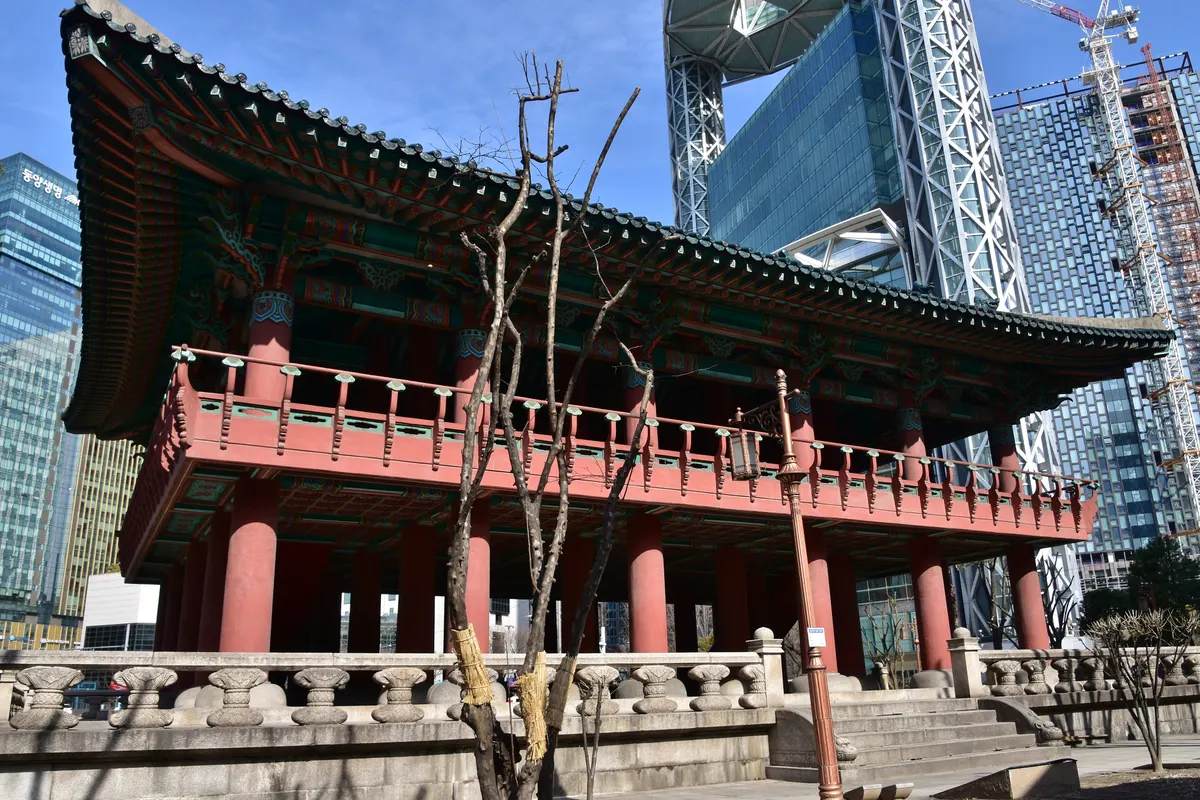
Bosingak stands on Jong-ro in central Seoul, next to Jonggak Station on Line 1. On New Year's Eve, though, the city usually has trains pass through Jonggak without stopping around midnight, so plan to walk in from a nearby station.
Good stations to use instead are City Hall, Gwanghwamun, Jongno 3-ga and Euljiro 1-ga, all within a short walk. Roads around the pavilion are closed to traffic for the evening, and police may limit entry when the crowd gets dense. Arrive well before 23:00 if you want to see the pavilion itself; large screens nearby show the ceremony to everyone further back.
Are there countdown events at Gwanghwamun and Myeongdong?
Usually, yes, but the program changes every year. Recent years have brought a light-show countdown at Gwanghwamun Square and a media-facade countdown on a department store front in Myeongdong.
Check the year's announcement from the Seoul Metropolitan Government and Jung-gu District in late December for times, places and road closures. Gwanghwamun Square is a short walk from Bosingak, so some people watch one countdown and catch the bell on a screen.
Does the Seoul subway run late on New Year's Eve?
In recent years, yes: the city has announced subway service extended to about 02:00 on January 1, along with later buses on routes that pass the ceremony area. The details are announced each December, so confirm them before you go.
Night buses (N buses) also run through the night on their normal routes. Taxis are hard to find right after midnight, so many people walk to a station a few stops away from Jongno before getting on a train.
How do you stay warm on New Year's Eve in Seoul?
Dress for standing still outside for an hour or more, because midnight in late December is often below freezing. Layers, a hat, gloves and warm shoes matter more than a heavy coat alone.
- Heat packs. Convenience stores sell disposable hand warmers (핫팩, hot packs) that you shake to warm up. Put one in each pocket.
- Thermal layers. A thin base layer under your clothes keeps you warm without bulk in the crowd.
- Hot snacks first. Eat before you go; street food near the bell is busy and the queue is cold.
- Warm-up spots. In recent years the city has set up warming shelters near Bosingak. Cafes and convenience stores nearby fill up fast.
- Phone battery. Cold drains batteries quickly, so carry a power bank for photos and the ride home.
Does the saju year change on January 1?
No. In saju, the year changes at ipchun (立春), the solar term called "the start of spring", not on January 1 or at Seollal. On the night the Bosingak bell rings for 2027, the saju year is still 丙午, the Fire Horse year of 2026.
Saju follows the 24 solar terms (節氣), which track the sun's position. The year begins when the sun reaches 315° of ecliptic longitude, which falls around February 4. PAL:JA computes these moments with fixed rules and gives them in Korea time:
| Moment (Korea time) | Year pillar | Month pillar | What it is |
|---|---|---|---|
| December 31, 2026, before midnight | 丙午 Fire Horse | 庚子 | New Year's Eve |
| January 1, 2027 | 丙午 Fire Horse | 庚子 | New Year's Day on the calendar |
| Early January 2027 | 丙午 Fire Horse | 辛丑 | Minor Cold (小寒) starts the Ox month |
| February 4, 2027, 10:46 | 丁未 Fire Goat | 壬寅 | Ipchun: the saju year 2027 begins |
| February 7, 2027 | 丁未 Fire Goat | 壬寅 | Seollal, Korean New Year |
So a baby born just after the bell on January 1, 2027 is a Horse in saju, not a Goat. The day pillar does change: December 31, 2026 is a 己卯 day and January 1, 2027 is a 庚辰 day.
When does 2027 begin in Korean astrology?
The saju year 2027 begins at ipchun, on February 4, 2027 at 10:46 Korea time. From that moment the year pillar is 丁未, the Fire Goat, until ipchun 2028.
That is three days before Seollal 2027 on February 7, which our guide to Korean New Year 2027 covers in full. What the Fire Goat year means animal by animal is in our post on the Year of the Goat 2027.
What is my zodiac sign if I was born in January?
If you were born between January 1 and ipchun, around February 4, your Korean zodiac animal is the one of the previous year. Someone born on January 20, 1991, for example, is a Horse in saju, not a Goat.
The exact ipchun moment moves by a few hours each year, so a birthday on February 3, 4 or 5 needs the year's own time. The free Chinese zodiac calculator checks it for any birthday.
Calculate your saju chart
Your zodiac animal comes from the year pillar alone. The full chart adds your month, day and hour, and your saju type, the Day Master, is the heavenly stem of your day pillar. Sign in and open your chart with 1 bok ($1.99) on the saju type page, using true solar time for your birth city.
Is it worth spending New Year's Eve at Bosingak?
Yes, if you want to see the Korean way of ringing in the year and you do not mind a dense, cold crowd. If you prefer comfort, watch the bell on television and go out early on January 1 for the first sunrise instead.
What time is the Bosingak bell rung?
The 33 strikes begin at midnight, as December 31 turns into January 1. The ceremony around it usually starts around 23:00 and ends a little after midnight.
Can tourists ring the Bosingak bell?
Not at the New Year ceremony, where the strikers are chosen in advance. Seoul has at times run daytime bell-ringing for the public outside the New Year, so check the city's current program if you want to try it.